Applications
Learning
 Part of the Oxford Instruments Group


GeoSpec benchtop TD-NMR determines key properties of rock cores, reservoirs, and fluids, accurately measuring oil and water volumes, porosity, permeability, wettability, capillary pressure, and saturation. Designed to replicate logging tools, it supports high-pressure, high-temperature studies, enables advanced petrophysics investigations, enhanced oil recovery (EOR), and carbon capture and storage (CCS / CCUS) research using intuitive software.
View Brochure Request Pricing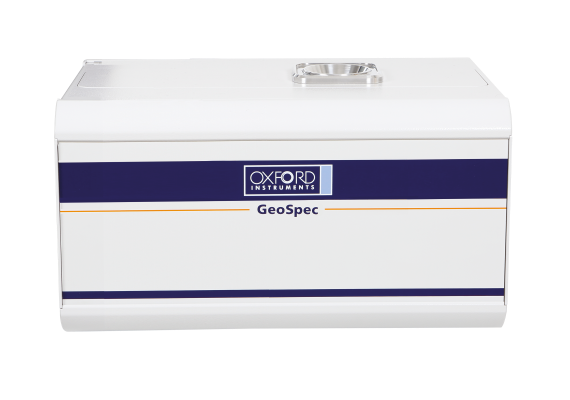
Benchtop time domain NMR (TD-NMR) is used to analyse key properties of rocks, reservoirs and fluids. NMR measures the total oil and water volume, oil and water content, porosity, permeability, capillary pressure, wettability, and fluid saturation. Characterising rock cores at high pressures and under core flooding conditions, the GeoSpec range of instruments advance Enhanced Oil Recovery (EOR) and the characterisation of carbon dioxide sequestration for carbon capture and storage (CCS). GeoSpec is designed to mimic the operation of NMR logging tools in the lab with high pressure cells that can operate at temperatures to 100°C.
| Model | Operating frequency (MHz) | Maximum sample diameter (mm) | Gradients | Green Imaging Software Options |
| GeoSpec LT | 23 | 29 | None | NMR ProLab Basic (custom version) |
| Model | Operating frequency (MHz) | Maximum sample diameter (mm) | Gradients | Green Imaging Software Options |
| GeoSpec 12 | 12 | 53 | None | NMR ProLab LithoMetrix or NMR ProLab Basic |
| GeoSpec 12/1D | 12 | 53 | 1D | NMR ProLab Basic or NMR ProLab Advanced |
| GeoSpec 12/3D | 12 | 53 | 3D | NMR ProLab 3D Imaging |
| Model | Operating frequency (MHz) | Maximum sample diameter (mm) | Gradients | Green Imaging Software Options |
| GeoSpec 2 | 2 | 53 | None | NMR ProLab LithoMetrix or NMR ProLab Basic |
| GeoSpec 2 | 2 | 53 | 1D | NMR ProLab Basic or NMR ProLab Advanced |
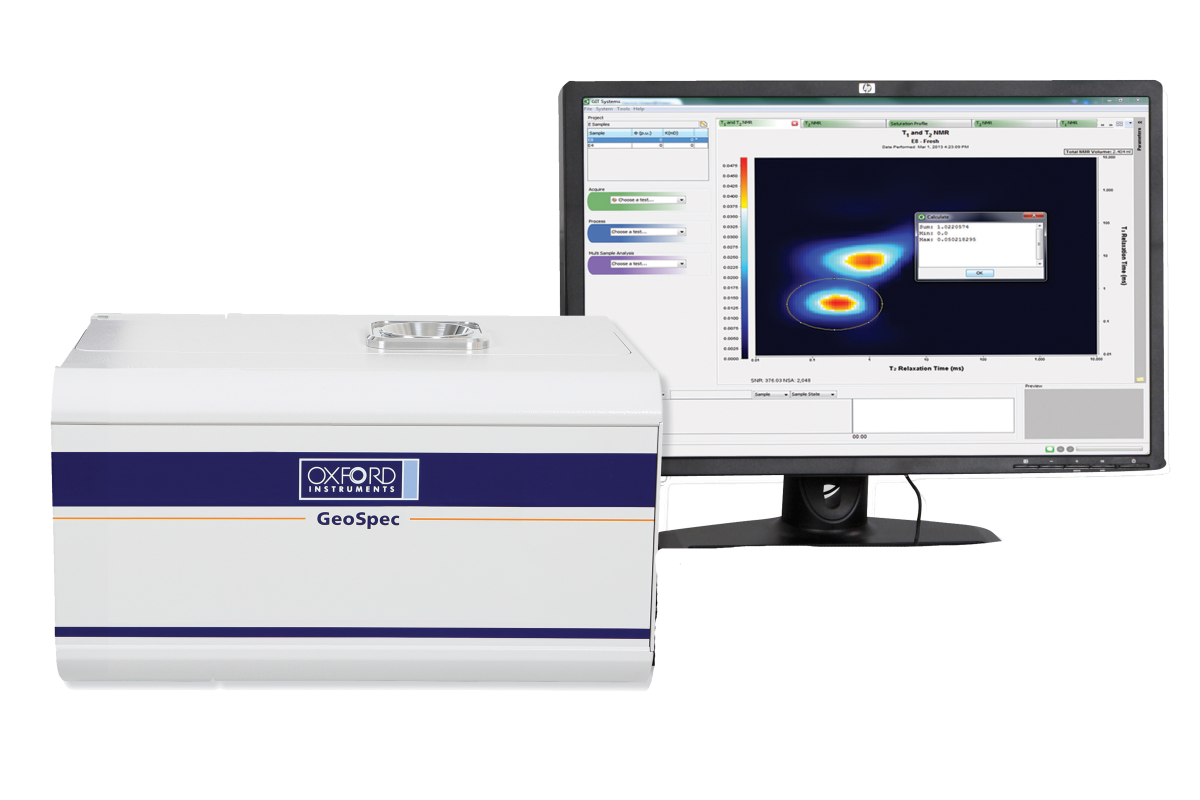
GeoSpec is the industry standard benchtop NMR rock core analyser, with installations in almost every major oil producer and SCAL laboratory world-wide for core handle samples from ½ to 2 inches diameter. Integrated Green Imaging software, and a comprehensive range of accessories, support routine rock core analysis through to advanced petrophysics research without the need for NMR expertise.
The GeoSpec Core Analyser 2 MHz models routinely measure relaxation distributions, allowing the prediction of basic petrophysical parameters such as porosity, free and bound fluid determinations from T₂ values. Higher field (12 and 23 MHz) models address high sensitivity applications including very low porosity samples, and Magnetic Resonance Imaging (MRI) that exploit 3D gradients.

Lower-frequency 2 MHz systems minimise artefacts from ferromagnetic materials and better replicate NMR logging tools. Mid-range 12 MHz instruments provide greater sensitivity, ideal for low-porosity samples or faster measurements. Higher-frequency 23 MHz systems deliver maximum sensitivity, making them best suited for analysing small samples where signal strength is critical.

Q‑Sense technology enables ultra-short echo times, allowing TD‑NMR systems to detect very small pores that would otherwise be missed. By combining these short echo spacings with high signal‑to‑noise ratios, it improves the accuracy of porosity measurements while also reducing acquisition times and delivering more reliable data for challenging samples such as tight rocks and shales.

A range of interchangeable probe sizes, from ½ inch to 2 inches diameter, allows GeoSpec systems to accommodate different core dimensions while maximising sensitivity and efficiency. By matching probe size to the sample, users can optimise signal-to-noise ratio, reduce measurement time, and ensure accurate, consistent results across varying core sizes.

Comprehensive analysis is further enabled by the fully integrated Green Imaging NMR ProLab software, supporting advanced workflows such as 2D mapping, diffusion measurements, capillary pressure, saturation profiling, and optional 3D imaging. A built-in project database organises samples, tracks measurements, and stores instrument performance data, ensuring reliable calibration and streamlined data management.

High-pressure P5 (up to 5,000 psi for 1.5-inch cores) and P10 (up to 10,000 psi for 1-inch cores) overburden cells for GeoSpec 2 MHz and 12 MHz instruments operate up to 100°C, replicate realistic reservoir conditions. They allow core flooding experiments under controlled confining pressures, with enhanced safety features and the ability to maintain pressure external to the instrument.

Pulsed field gradients options for the GeoSpec system enhance its NMR capabilities by enabling advanced diffusion, flow, and imaging measurements within rock cores. These options allow advanced measurements such as capillary pressure, saturation profiles and 2D data analysis for fluid typing, providing deeper insight into fluid behaviour and distribution.
Designing advanced materials and reservoir systems for carbon capture, utilisation and storage is critical to reducing CO₂ emissions. TD‑NMR-based GeoSpec systems characterise CO₂ behaviour in rocks by measuring porosity, permeability, and pore size distribution, enabling accurate assessment of storage performance in core samples under realistic high-pressure reservoir conditions.
Downhole NMR tools are widely used in oil and gas exploration to measure T₂ distributions along a well. These measurements relate to pore size and enable differentiation between bound and free fluids, allowing reservoir engineers to estimate fluid mobility and calculate the volume of recoverable reserves more accurately.
Capillary pressure is essential in oil exploration, but traditional measurement methods are slow, complex, and costly. The GIT‑CAP technique combines capillary pressure theory with NMR-derived saturation profiles, using centrifuged, fluid-saturated core samples to rapidly generate accurate capillary pressure curves, improving efficiency and reducing time compared to conventional laboratory approaches.
NMR quickly measures porosity and pore size distribution by detecting signals from fluids within a sample. After excitation, the signal decays over time (T₂), where initial amplitude reflects total fluid content and relaxation behaviour provides insight into the pore environment, including the size and characteristics of fluid-filled spaces within materials.
The P5 and P10 overburden cells are purpose-built for the GeoSpec range, delivering optimised compatibility, usability, and NMR performance.
For sample handling, core samples can be loaded and pressurised outside the instrument using a dedicated stand. This allows samples to equilibrate at pressure, often over extended periods, while the NMR system remains available for other measurements, improving overall laboratory efficiency.
To maximise NMR performance, the cells use a specially engineered ceramic pressure vessel that minimises the distance between the RF coil and the sample, supporting high signal-to-noise ratios (SNR). Q-Sense technology enables short echo spacings, while carefully selected materials reduce background signal and enhance sensitivity.
Safety is integral to the design. Each cell is enclosed within a protective metal shield to contain potential failures, and a built-in burst disc provides reliable overpressure protection during operation both inside and outside the instrument.
| Specification | P10 - 1" diameter cores | P5 - 1.5" diameter cores |
| Rock Plug size | Diameter - 1.0", Length - Up to 2" | Diameter - 1.5", Length - Up to 2" |
| Maximum Working Pressure | 10,000psi | 5,000psi |
| Maximum Working Temperature | 100°C | 100°C |
| Safety Features | Main pressure component tested to three times rated pressure; Secondary containment; Integrated burst disc and pressure gauge; Drop (shock) protector; CE certified | Main pressure component tested to three times rated pressure; Secondary containment; Integrated burst disc and pressure gauge; Drop (shock) protector; CE certified |

© Oxford Instruments 2026

 Powered by Bioz