Introduction
Fat is an important nutritional parameter in milk because it is the richest energy component and its content is highly regulated; milk or butter fat also has high value. Milk fat which is composed of a wide range of fatty acids can vary due to various factors and processes, affecting the quality and flavour of the product. This calls for a reliable and accurate measurement to enable the characterisation and quality control of dairy products in food industry.
Advantages of NMR
Both Gerber volumetric and Mojonnier extraction are classic methods for the quantitative analysis of fat content in milk. However, these methods entail the use of hazardous solvents and chemicals, which are undesirable according to international environmental standards. Also, a trained specialist is required to perform the extraction which is a time-consuming and laborious process. In addition to traditional methods, Near Infra-Red (NIR) can be considered as an alternative for the determination of fat content in foodstuffs. However, it requires extensive calibration and suffers from low reproducibility which limits its application for quality control purposes.
In contrast, the MQC+ benchtop Nuclear Magnetic Resonance (NMR) analyser offers an accurate reproducible and quick method along with minimal sample preparation and requirement for an NMR expert; this makes it favourable for routine measurements in the laboratory. Furthermore, the NMR calibration is linear which means fewer samples are required for calibration and, in principle, can be gravimetrically determined; this means that it has the potential to be a primary method.
Method
In this technique, the fat content is quantified using an appropriate calibration curve compared to the concentration defined by a reference method. The samples are stabilised at 50°C or other temperature above the melting point of the fat prior to measurement.
Calibration
The MQC+ calibration can be carried out using only two standards depending on the accuracy of the samples. However, calibration error can be significantly reduced by the usage of more standards, preferably 3–6, and even more over the range of interest.
In this case, calibration was obtained by measuring certified reference pasteurized milk with predefined fat contents reported by QSE GmBH which resulted in a good correlation with an R-value of 1.0 and a standard deviation of 0.01% (Figure 1). The reference as well as calculated values determined by NMR are compiled in Table 1.
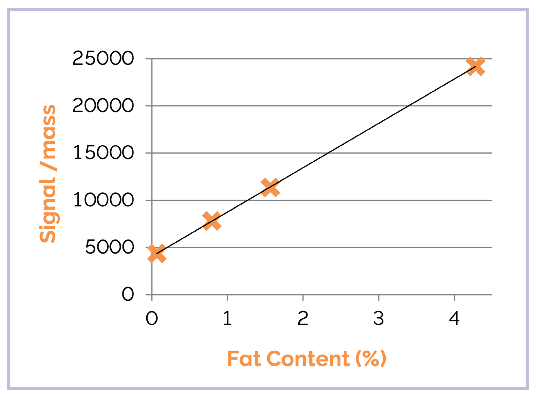
Fig. 1 — NMR calibration for fat contents ranging from 0.064–4.280% [g/100g] in Pasteurized milk. Measurement was performed on the Oxford Instruments MQC+ benchtop NMR analyser using a 26 mm diameter probe.
Table 1. A comparison of fat content values obtained by a reference technique to those determined from NMR calibration.
| Sample | Ref. Value (%)[g/100g] | NMR Value (%) | Diff. (%) |
| 1 | 0.064 | 0.058 | -0.01 |
| 2 | 0.792 | 0.810 | 0.02 |
| 3 | 1.560 | 1.546 | -0.01 |
| 4 | 4.280 | 4.282 | 0.00 |
Measurement
The Pasteurized milk was poured into vials, weighed, and subsequently dried on an infrared dryer. Then, the samples were conditioned at 50°C for 30 min before inserting into the bore of the magnet for analysis. Each measurement takes only 16 seconds per sample.
Results
The repeatability of NMR measurement was tested by analysis of samples 3 and 4, 10 more times revealing promising results (Table 2).
Table 2. Results of instrument repeatability test.
| Repeat | Measured Fat content (%) — Sample 3 | Measured Fat content (%) — Sample 4 |
| 1 | 1.669 | 4.462 |
| 2 | 1.663 | 4.465 |
| 3 | 1.650 | 4.466 |
| 4 | 1.658 | 4.442 |
| 5 | 1.676 | 4.472 |
| 6 | 1.688 | 4.450 |
| 7 | 1.686 | 4.443 |
| 8 | 1.688 | 4.456 |
| 9 | 1.698 | 4.441 |
| 10 | 1.691 | 4.444 |
| Average | 1.677 | 4.454 |
| Standard Deviation | 0.015 | 0.011 |
Summary
- Benchtop NMR delivers fast, repeatable quality control measurement of fat content in milk.
- NMR is very stable over the long term and rarely requires calibration adjustment.
- Measurement values and precision are comparable to less desirable wet chemical methods.
- It can be performed by non-specialised personnel and requires minimal sample preparation.