Measuring the oil content of Jatropha seeds is important for two reasons: firstly, for non-destructive measurement of
single seeds, to select high oil content specimens for propagation, secondly, for bulk measurement of oil content for
trading or processing.
Method
Solvent extraction techniques are often used for the measurement of oil content of seeds. However, they tend to be
time consuming, cumbersome, and require the use of skilled personnel. There is also a financial cost involved in the
purchase and disposal of the solvent chemicals.
Secondary methods for measurement of oil content in Jatropha seeds include Near Infra-Red (NIR) spectroscopy.
However, NIR relies on reference values given by solvent extraction techniques. Furthermore, the hard and uneven
surface of the Jatropha seed interferes with the signal obtained from NIR unless the seeds are ground, thus making
them unviable.
Measurement of the oil content in seeds was one of the first applications for Nuclear Magnetic Resonance (NMR), as
far back as the late 1970s. Since then, NMR has been proven to be suitable for a wide variety of seeds, but only now
has it been tested for the measurement of oil content in the seeds of Jatropha.
NMR has a number of advantages over solvent extraction and NIR:
- It can be calibrated to cover a concentration range from 0 to 100%.
- It can be calibrated using a single sample of 100% Jatropha oil.
- NMR is very stable over the long term, so calibrations will rarely need to be adjusted.
- The measurement time is short (typically 16 seconds).
- NMR is insensitive to seed surface roughness, seed shape, or air voids between seeds.
- The technique is non-destructive, so seeds analysed may be crushed for oil or planted.
- Both single seeds and bulk seeds can be measured for oil content.
Calibration and Results
21 Jatropha seeds were selected for the analysis of oil content. The seeds were divided into batches of three seeds
(the minimum required for Weibull-Stoldt (W-S) analysis). Both single seeds and triplets of seeds were analysed
against a 100% Jatropha oil calibration. From single seed values, a weighted average for the oil content of each batch
was calculated. Table 1 summarises the results for the weighted averages of single seed NMR values for each batch.
| Batch |
Oil Content (%) W-S |
Oil Content (%) NMR |
Absolute Difference |
| A |
37.10 |
37.23 |
-0.13 |
| B |
24.65 |
23.85 |
0.80 |
| C |
28.70 |
28.11 |
0.59 |
| D |
30.91 |
31.24 |
-0.33 |
| E |
33.39 |
33.37 |
0.02 |
| F |
36.53 |
36.27 |
0.26 |
| G |
37.23 |
36.32 |
0.91 |
Table 1: Lists and compares single seed NMR and W-S values for oil content.
Table 2 summarises the results for triplet seed NMR values.
| Batch |
Oil Content (%) W-S |
Oil Content (%) NMR |
Absolute Difference |
| A |
37.10 |
37.67 |
-0.57 |
| B |
24.65 |
23.94 |
0.71 |
| C |
28.70 |
27.98 |
0.72 |
| E |
30.91 |
31.48 |
-0.57 |
| F |
33.39 |
33.77 |
-0.38 |
| G |
36.53 |
36.26 |
0.27 |
| J |
37.23 |
36.71 |
0.52 |
Table 2: Lists and compares triplet seed NMR and W-S values for oil content.
The NMR values for each batch were compared with the value provided for each seed batch by W-S extraction. The
correlation between the NMR and W-S values for oil content is shown in Figures 1 and 2.
The correlation coefficients for both graphs indicate an excellent correlation between NMR and W-S values for oil
content of Jatropha seeds. The similarity of the two graphs shows that both single seed and triplet seed analysis are
suitable methods for measuring the oil content of Jatropha.
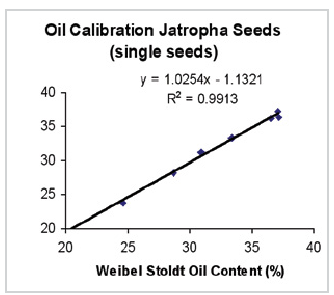
Fig. 1 — Comparing single seed NMR and W-S values for oil content.
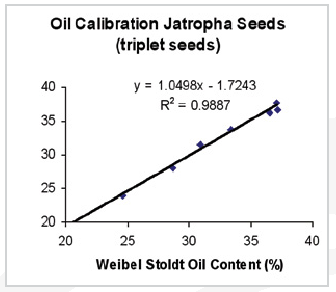
Fig. 2 — Comparing triplet seed NMR and W-S values for oil content.
Table 3 shows that the repeatability (or precision) of the NMR measurement of the same sample (whether single seed or
a triplet of seeds) is excellent.
| Repeat |
Oil Content (%) Single Seed |
Oil Content (%) Triplet Seed |
| 1 |
19.63 |
37.82 |
| 2 |
19.68 |
37.67 |
| 3 |
19.60 |
37.85 |
| 4 |
19.60 |
37.83 |
| 5 |
19.58 |
37.84 |
| 6 |
19.60 |
37.90 |
| 7 |
19.61 |
37.93 |
| 8 |
19.61 |
37.96 |
| 9 |
19.62 |
37.91 |
| 10 |
19.59 |
37.93 |
| Standard Deviation |
0.028 |
0.084 |
Table 3: Repeatability measurements of single and triplet Jatropha seeds by NMR.
The precision of the NMR data far outstripped that of the W-S data, which is shown in Table 4.
| Batch |
Oil Content (%) 1 |
Oil Content (%) 2 |
SD |
| A |
36.94 |
37.23 |
0.23 |
| B |
25.01 |
24.28 |
0.52 |
| C |
28.46 |
28.94 |
0.34 |
| D |
30.01 |
31.81 |
1.27 |
| E |
33.77 |
33.01 |
0.54 |
| F |
36.84 |
36.22 |
0.44 |
| G |
38.26 |
36.19 |
1.46 |
Table 4: Lists the W-S duplicate values for oil content.