Application
Molecular weight (MW) is one of the crucial characteristics of polymers. It correlates with the structural features of macromolecules (polymer chain length, branching and copolymerisation transformations) which in turn affects the physical properties of materials and polymer-based products. Molecular weight measurements are considered "a must" at various steps in polymer production, especially for quality control but also in research and development of new materials.
Summary
- Fast, accurate and repeatable
- No sample preparation
- No hazardous solvents or high temperatures
- Simple linear calibration
- Simple and reliable technique, suitable for unskilled personnel
Advantages of NMR
There are several techniques used for the determination of polymer molecular weight:
- Gel permeation chromatography (ASTM D5296)
- Viscometry (ASTM D1601, ASTM D4603 and ASTM D1243)
- Light Scattering (ASTM D4001)
All these methods require dissolution of the polymers in organic solvents and in some cases using elevated temperatures, both of which introduce unwanted risks in the work environment, significant costs for consumables and high energy consumption. In contrast to these wet chemistry methods, time-domain Nuclear Magnetic Resonance (NMR) does not require either the dissolution step or the use of high temperatures.
The MQC+ benchtop Nuclear Magnetic Resonance (NMR) analyser provides an alternative method which is quick and easy to perform, simple to calibrate, and requires minimal sample preparation. As such it is ideal for routine operation in either a laboratory or production environment without any requirement for additional chemicals or specialist operator training.
Method
The NMR technique is based on measuring the NMR response from a whole polymer sample (powder or pellets). MW is quantified using the linear relationship (calibration) between the NMR data and reference values from a set of polymer samples with known MW.
Calibration
Ultimately, only two well-known standards are required to calibrate the instrument as the calibration is linear. However initially it is recommended that the instrument is calibrated by 3–6, preferably more, standards with known molecular weight values evenly spread over the range of interest. NMR is a comparative technique therefore cannot be more accurate than the reference technique against which it is being compared; error is reduced by analysing more reference samples.
Measurements
Polymer samples are poured into 18 mm glass NMR tubes up to a predefined mark; sample weighing is not required for this measurement. The sample tubes are placed in a temperature-controlled conditioning block at 40°C for 20 minutes prior to analysis. Measurement time is 40 seconds per sample.
Results
Figure 1 shows an example of a calibration for molecular weight of polyolefins with MW values from 864 to 9360 kg/mol. As seen in this figure, NMR gives an excellent linear correlation between the NMR response and the reference MW-values.
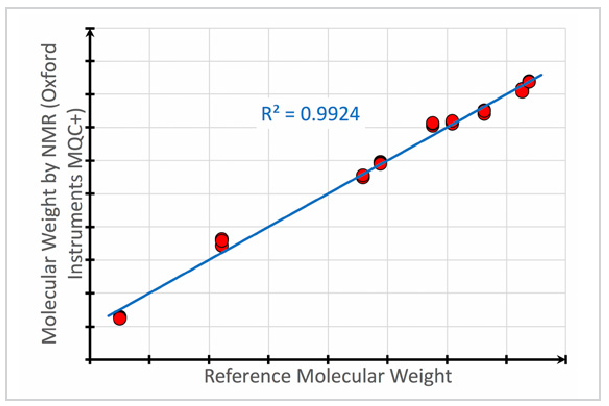
Fig. 1 — Calibration for measuring MW in polyolefin samples. Correlation coefficient R²=0.9924, standard deviation 0.0956, variance 0.0091.
The instrument repeatability was tested by measuring two samples five times. Table 1 shows the repeatability test results.
| Sample ID | Reference MW, kg/mol | Repeat | MW by NMR, kg/mol | Average MW for 5 repeat NMR measurements, kg/mol | Standard deviation for 5 repeat NMR measurements, kg/mol | Relative standard deviation for 5 repeat NMR measurements, % |
| Sample 1 | 864 | 1 | 803 | 800 | 24 | 3 |
| 2 | 786 |
| 3 | 771 |
| 4 | 844 |
| 5 | 797 |
| Sample 2 | 8980 | 1 | 8548 | 8543 | 179 | 2 |
| 2 | 8660 |
| 3 | 8554 |
| 4 | 8215 |
| 5 | 8738 |
Conclusions
- NMR is very stable over the long term and rarely needs calibration adjustment.
- NMR is insensitive to air voids between the pellets or grains of powder.
- Measurement precision is good compared to traditional methods.
- Sample measurement time is rapid.
- The NMR technique is non-destructive so the same sample may be measured several times before being analysed by other techniques.
- The NMR instrument may be used for measurement of other polymer quality control characteristics.