Modern toothpastes are designed to do more than just clean teeth. Hence, they contain many additives, either for
health or for cosmetic reasons, such as components to prevent tooth decay, colorants, flavours and preservatives.
Fluorine containing compounds (fluorides) are important additives of modern toothpastes as they protect the enamel by
decreasing the number of bacteria and preventing demineralising of teeth. However, toothpastes are classified as
drugs, not cosmetics, therefore the level of fluorides must be carefully controlled and measured accurately at
different stages of production and product release.
Advantages of NMR
Conventional methods currently in use for determining the fluoride content such as titration, ion selective
electrodes or ion chromatography are time consuming, require a trained analyst, and may involve the use of chemicals
for changing the pH of the test solutions.
The MQC+ benchtop Nuclear Magnetic Resonance (NMR) analyser offers a simple, non-destructive and rapid method for the
measurement of fluoride concentration in toothpastes. NMR detects the soluble fluoride content in toothpastes, which
is the most important parameter in determining its effectiveness in oral care. The two main fluorine based additives
are sodium fluoride (NaF) and sodium monofluorophosphate (MFP). Most toothpastes contain between 0.05 and 0.15
weight-% (500 to 1500 ppm) of fluorides, a level that is easily detectable by NMR.
Although the oral care products can be either a gel or paste with a wide variety of additives, NMR does not exhibit
significant change in performance with different formulas. This method may be used for routine analysis in a
production environment without any requirements for additional chemicals or specialist operator training.
Summary
- Fast, accurate, repeatable and non-destructive
- No sample preparation
- Simple linear calibration
- Easiest, most reliable technique available; suitable for unskilled personnel
Method
The analytical technique is based on direct measurement of the Nuclear Magnetic Resonance (NMR) signal of fluorine-19
which has 100% natural abundance. The acquired NMR signal is normalised by the sample mass and then the fluoride
content (ppm) is calculated using an appropriate calibration curve.
Calibration
It is possible to calibrate the MQC+ analyser using only two aqueous solutions of sodium fluoride. However, if a more
advanced calibration is required, it is recommended that the instrument is calibrated by 3-6 (or more) standards with
known fluoride content spread over the range of interest.
Figures 1 and 2 show NMR calibrations for adult (fluoride content 1200-1820 ppm) and children's (fluoride content
0-1000 ppm) toothpastes.
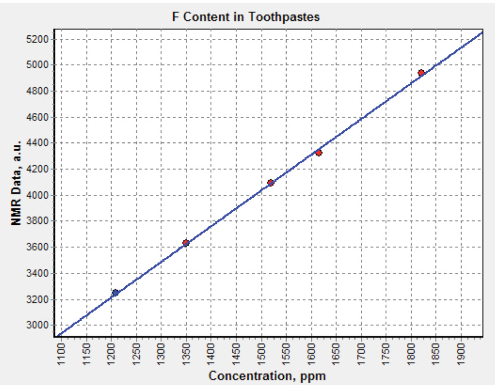
Fig. 1 — NMR calibration for fluoride in adult toothpastes (R² = 1.000, SD = 7 ppm); aqueous sodium fluoride
solutions were used as calibration standards.
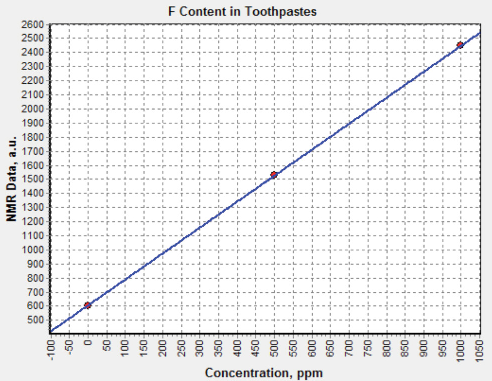
Fig. 2 — NMR calibration for fluoride in children's toothpastes (R² = 1.000, SD = 2 ppm); aqueous sodium
fluoride solutions were used as calibration standards.
Measurement
A tared sample vial is filled to a given height with a toothpaste sample, weighed, then transferred to a longer
length tube prior to NMR analysis. The recommended measurement time for samples of adult products with sodium fluoride
is 5 minutes per sample and for adult products containing MFP is 12 minutes per sample. For children's products,
the recommended measurement times are 10 and 24 minutes per sample, respectively. The samples may be conditioned at
40°C for better repeatability.
Results
Table 1 compares the reference values of various toothpastes against the fluoride contents measured by NMR. Tables 2
and 3 demonstrate the repeatability and reproducibility of the NMR technique.
| Sample ID |
Given Fref, ppm |
Predicted NMR F-content FNMR, ppm |
Difference (Fref-FNMR), ppm |
| 1 |
500 |
505 |
-5 |
| 2 |
1000 |
1001 |
-1 |
| 3 |
1450 |
1446 |
+4 |
Table 1. Comparison of the reference values of various toothpastes against the fluoride contents measured by
NMR
| Reference F-Content, ppm |
Repeat NMR Measurements: F-Content, ppm |
Mean F-Content, ppm |
Standard Deviation, ppm |
| 1447 |
1465 |
1445 |
1441 |
1452 |
1438 |
1448 |
11 |
Table 2. NMR results for repeat measurements of the same sample of an adult toothpaste
| Reference F-Content, ppm |
F-Content in Different Toothpaste Portions by NMR, ppm |
Mean F-Content, ppm |
Standard Deviation, ppm |
| 1410 |
1393 |
1422 |
1438 |
1413 |
1407 |
1415 |
17 |
Table 3. NMR results for different portions of the same adult toothpaste
Conclusion
- A primary calibration can cover the fluoride concentration range required in the industry, typically between 200
and 2000 ppm
- NMR is very stable over the long term and rarely needs re-calibration
- NMR techniques require minimal sample preparation without the use of solvents and other media
- NMR measurement precision is excellent compared to conventional methods
- Repeatability and reproducibility of the NMR method meet all industrial requirements for routine 19F
analysis
- Faster measurement and requiring much less operator time than conventional methods
- The NMR technique is non-destructive so the same samples may be measured several times before being analysed by
other techniques
Complete Package
Oxford Instruments offer a package especially tailored to the measurements of fluoride content in oral care products:
- Oxford Instruments MQC+F NMR Analyser
- 0.55 Tesla (22 MHz) high homogeneity magnet
- Probe for 26 mm diameter sample tubes (10 ml sample volume)
- Integrated system controller (no external PC required)
- Integrated flat-screen display
- MultiQuant software including RI Calibration, RI Analysis, and
the EasyCal 'Fluoride Content in Toothpaste' application which guides the user through the
calibration and analysis procedures
- Test/tuning samples
- Glass tubes with inserts for easy and fast sample preparation
- User manuals
- Method sheet
Optional items:
- A precision balance (3 decimal places)