Introduction
In this application note, we present case studies highlighting how benchtop NMR characterises phosphorus containing compounds and materials across their lifecycle. Phosphorus naturally occurs in phosphate containing rocks, is active in living organisms and hence a cornerstone of life. Phosphorus containing compounds are important in industries including agriculture, chemical manufacturing, pharmaceuticals, and energy.
In agriculture, as a nutrient necessary for plant growth, phosphate fertilizers promote the development and maturation of plants. Phosphorus-containing pesticides and insecticides help improve the quality and yield of crops. In the chemical industry, phosphates and phosphides are contained in coatings, flame retardants, and detergents. In the field of medicine, phosphorus compounds are used as active ingredients (APIs) and excipients in the synthesis of antiviral and anticancer drugs and as biomolecule labels. In batteries, lithium-ion phosphate, and lithium hexafluorophosphate, are critical components in high power density current carrying electrolytes.
To manufacture high-quality phosphorus-containing products, it is necessary to characterize and analyse the target substances at all stages of production; to ensure that the product identity and purity is as required. The composition structure, purity and concentration of compounds containing phosphorous-31 is straightforward to analyse with benchtop NMR spectroscopy. With a natural abundance of 100%, a nuclear spin of one-half, and a high receptivity (relative to ¹³C) of 391; these properties make ³¹P one of the easiest nuclei to study by NMR. In addition, since the number of phosphorus atoms per molecule of phosphorus-containing compounds is generally small, the resulting spectra will be relatively simple. Cryogen free benchtop NMRs can be widely applied to characterise phosphorus containing compounds across both R&D and manufacturing workflows.
This application note will present several examples of benchtop NMR ³¹P spectroscopy to assist in the characterization of phosphorus-containing compounds.
Applications of Benchtop ³¹P NMR Spectroscopy
Detecting Oxidation and Degradation of Raw Materials
Phosphorus is most commonly present in compounds in +3 or +5 oxidation states. The different oxidation states may be difficult to distinguish with conventional analytical methods. For example, in Figure 1, spectra of four compounds are shown:
- triphenylphosphine, PPh₃;
- triphenylphosphine oxide, OPPh₃;
- triphenylphosphite, P(OPh)₃; and
- triphenylphosphate, OP(OPh)₃.
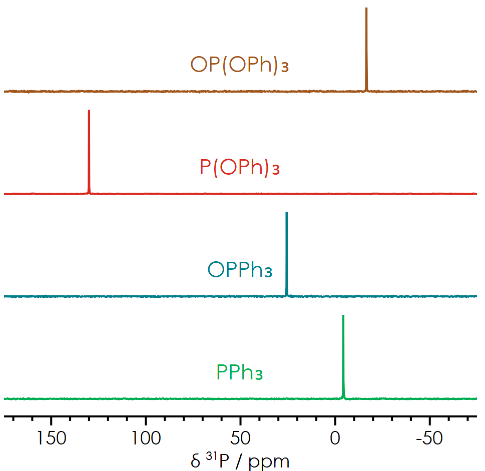
Fig. 1 — One-dimensional ³¹P{¹H} NMR spectra of trivalent and pentavalent phosphorus containing compounds
These compounds have similar molecular structures, with PPh₃ & OPPh₃, and P(OPh)₃ & OP(OPh)₃, only varying in their oxidation state and the presence of a single oxygen atom. In the common one-dimensional ¹H or ¹³C{¹H} NMR experiments spectra, these compounds are effectively indistinguishable. However, the compounds can clearly be distinguished in the ³¹P{¹H} NMR spectrum, with the chemical shifts of the different compounds varying over a ca 150 ppm range.
If there are phosphorus-containing raw materials or products that are prone to oxidation and deterioration, then ³¹P NMR spectroscopy is an effective method for detection and analysis of chemical degradation, potentially solving the problem with a single rapid measurement.
Analysis of Small Nucleoside Active Pharmaceutical Ingredients (APIs)
Compared with traditional small molecule and antibody drugs, small nucleic acid drugs intervene from the source of genes and have been described as "treating the symptoms and the root cause". Hence they have become a promising new direction for drug development. Modified nucleosides and phosphoramidite monomers (Figure 2) are the core raw materials for the synthesis of small nucleic acid drugs, and their quality is one of the key links in the quality control strategy of small nucleic acid drugs.

Fig. 2 — Molecular structure of phosphoramidite monomers; R groups include OH, F and OCH₃
A small nucleoside raw material manufacturer prepared four different phosphoramidite monomer products. One-dimensional ³¹P spectra of products N1, N2, N3 and N4 were acquired using the Oxford Instruments X-Pulse Broadband Benchtop NMR Spectrometer (Figure 3). It can be seen that the resonance signal of the target product, phosphoramidite, is located at a chemical shift of ca δP 150 ppm. Although the four products are broadly similar in chemical composition, we can clearly observe the difference in the ³¹P splitting pattern in the spectra (Figure 2 inserts). Therefore, benchtop NMR can provide a direct and effective analytical method for the differentiation and identification of individual products.
In addition, the signal peaks of impurities or degradation products are clearly shown in the spectra of all four samples. The quantitative nature of NMR easily measures the relative content of the target product and impurities. Therefore, benchtop NMR enables evaluation of the quality, condition, and stability of the product. For example, there are more and stronger impurity signals in sample N1, indicating that the product has degraded more than the other three. Benchtop NMR can also be used as a quality control tool for the preparation and production of small nucleic acid drug products.
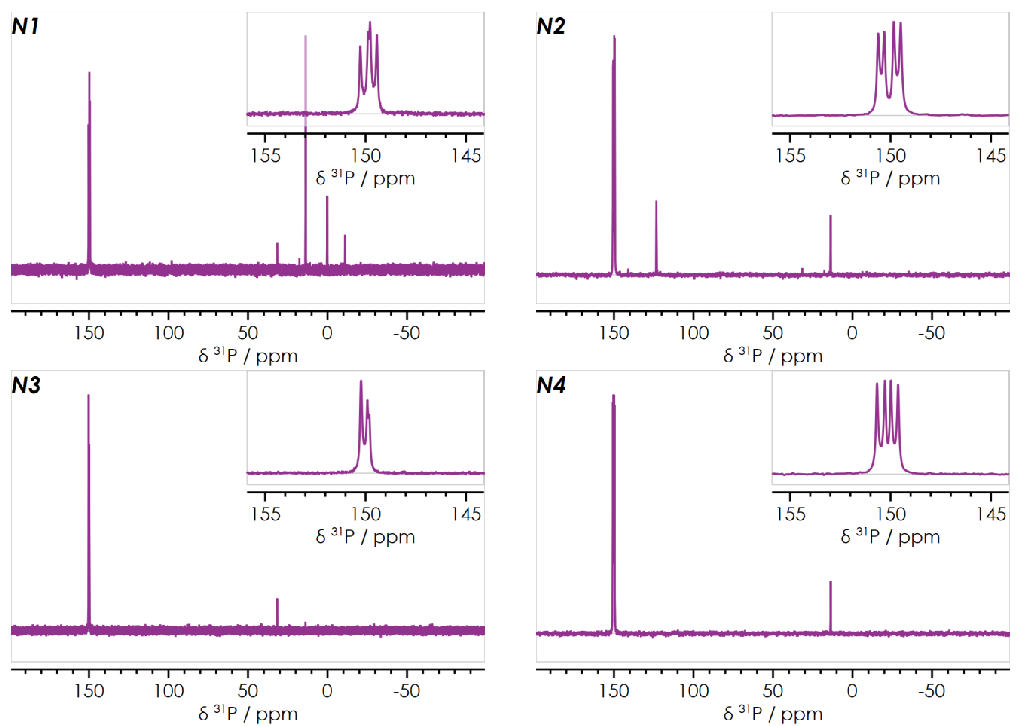
Fig. 3 — One-dimensional ³¹P{¹H} spectra of four phosphoramidite samples (N1, N2, N3, N4). The chemical shift ~150 ppm signal is enlarged in the inset plot.
Battery Electrolyte Analysis
Low cost lithium hexafluorophosphate, Li[PF₆], is highly soluble and thermally stable in alkyl carbonate solvents, has strong ion-diffusion and migration capabilities. These advantages have led to its large-scale industrial production, and use as the most common lithium salt in commercial lithium-ion battery electrolytes. However, [PF₆]⁻ is sensitive to water, and trace moisture in the air is sufficient for it to decompose through hydrolysis. Therefore, the production and storage of Li[PF₆] needs to be strictly controlled and tracked.
In the one-dimensional ³¹P NMR spectrum (Figure 4 above), the phosphorus atom of [PF₆]⁻ is coupled to six equivalent fluorine atoms and therefore splits to give a seven-peak signal, with peak intensities in a 1:6:15:20:15:6:1 ratio. After exposing [PF₆]⁻ to atmospheric moisture, a new signal of three peaks in a 1:2:1 ratio is observed in the one-dimensional ³¹P spectrum, in addition to the original seven peak signal (Figure 4 below).
This is due to the degradation of a portion of [PF₆]⁻ to form difluoro-phosphoric acid, OP(F)₂(OH), with the splitting into three peaks caused by coupling to two equivalent fluorine atoms. Benchtop NMR is a powerful tool to identify electrolyte degradation products and the root causes of failure.
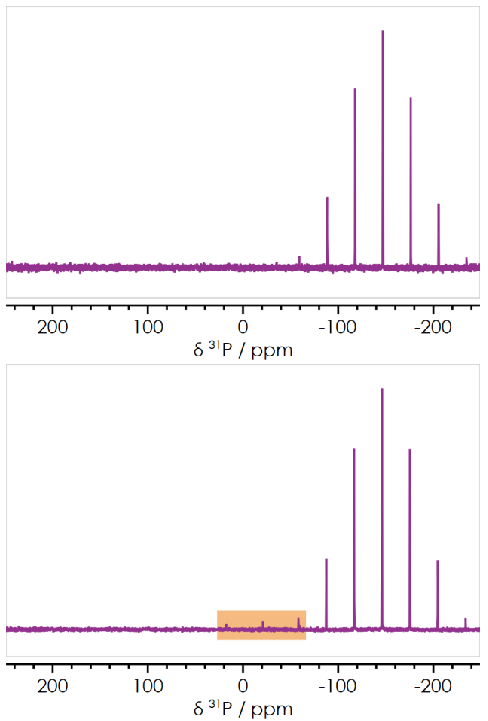
Fig. 4 — One-dimensional ³¹P spectra of a Li[PF₆] containing electrolyte sample; spectrum acquired immediately after opening (above), and after seven hours exposure to moist air (below).
Additives both enhance the performance and extend the lifetime of Li-ion battery electrolytes. For example, nitrates are mainly used to improve cycling performance, sulfites to enhance low-temperature performance, and phosphate esters and fluorinated substances to improve flame retardancy and safety. Figure 5 shows the one-dimensional ³¹P spectra of phosphorus-containing additive samples from two different companies. Through the comparison of the spectra, it can be seen that the additives selected by the two companies have very different chemical compositions and structures.
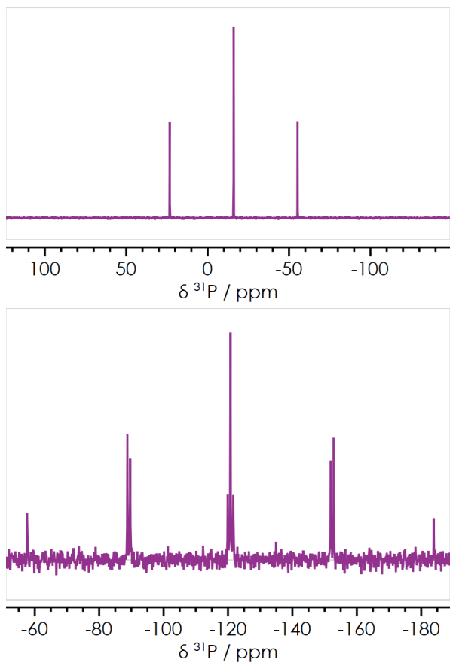
Fig. 5 — One-dimensional ³¹P spectra of phosphorus-containing additives from two different companies.
NMR structural and compositional characterisation is key for R&D of new additives — for example tris(trimethyl-silane) phosphate (TMSP) and tris(trimethyl-silane) phosphite (TMSPi). Their main functions are to form a protective film, to reduce electrolyte decomposition, and remove water and acid. The one-dimensional ¹H spectra of these two species are indistinguishable. However, there is a ca 300 ppm difference between the chemical shifts of TMSP and TMSPi in their ³¹P spectra (Figure 6).
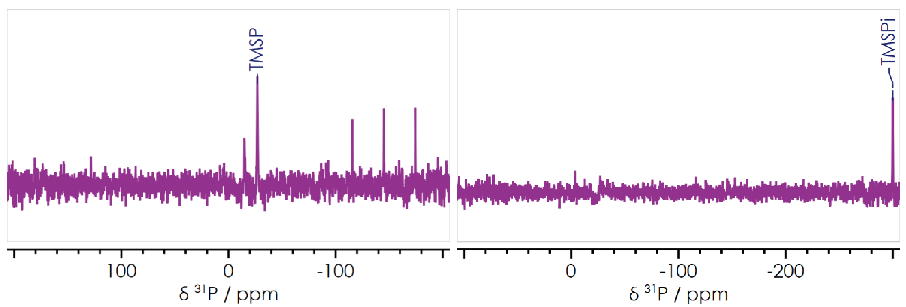
Fig. 6 — One-dimensional ³¹P spectra of phosphorus additives TMSP (left) and TMSPi (right) in samples of battery electrolyte
Benchtop NMR spectroscopy is a powerful tool for the characterization and analysis of battery electrolytes across their full lifecycle. The broadband X-Pulse system enables data from ³¹P NMR to be combined with analysis of other chemical nuclei (inc. ⁷Li, ²³Na, ¹¹B, ¹⁹F, ¹³C, ¹H) to give a comprehensive characterisation of all key electrolyte constituents.
Improving Chemical Synthesis Processes
A large chemical company provided two sets of four synthetic products to collect one-dimensional ³¹P{¹H} spectra on the X-Pulse. The spectra of the first set of products, S1 and S2, are basically the same (Figure 7 left). The largest difference was of the signals in the range δP 160–170 ppm, where there were some more impurity peaks in product S2, in comparison to product S1.
The main peak of the other pair of samples, Y1 and Y2, is around δP 163 ppm (Figure 7 right). However, the other signals of product Y1 are significantly stronger than those of Y2, especially the signal at ca δP 133 ppm.
The spectral data obtained from these experiments enable manufacturing process optimisation to reduce chemical impurities by changing synthesis conditions and processing methods. This example highlights how benchtop NMR phosphorus spectra enable interventions to increase product quality and yield and reduce cost of production.
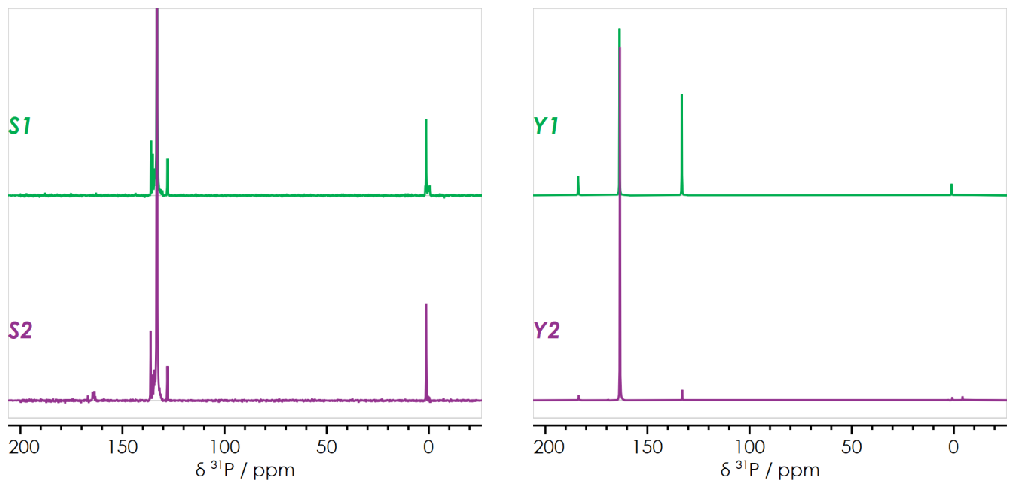
Fig. 7 — One-dimensional ³¹P{¹H} spectroscopy is used to evaluate chemical products and preparation processes
Summary
Phosphorus-31 NMR spectroscopy is a direct and effective characterization method for detecting phosphorus signals in compounds without interference from other elements. Across many industries and for academic research, it provides structural and chemical characterisation, quantification of purity and concentration and mapping of synthesis reaction effectiveness.
The Oxford Instruments X-Pulse Broadband Benchtop NMR Spectrometer is easy to operate and maintain. Its capability to measure a wide range of nuclei in addition to ³¹P provides comprehensive characterisation of compounds and end products to accelerate R&D and improve manufacturing efficiency.