Summary
- Fast, accurate and repeatable
- No sample preparation
- Simple linear calibration
- Easiest, most reliable technique available; suitable for non-technical personnel
Application
Fluorinated coatings are often applied to fibres and textiles to modify their properties. For example, fluorocarbon-based finishes are often applied to carpet fibres to provide oil or water repellent properties. Furthermore, Teflon is applied to textiles to provide easy cleaning, water resistance and fire-retardant properties. Therefore, there is a requirement to measure the amount of fluorinated coating to optimise the process and, in turn, the properties of the product.
Advantages of NMR
Conventional wet chemical methods used to determine fluorine content include ion selective electrode and ion chromatography. Both methods are time-consuming, require skilled chemists and involve the use of potentially hazardous chemicals which require disposal, all of which contribute to the cost of the analysis.
The MQC+ time domain NMR analyser offers a rapid, easy and non-destructive method for measurement of fluorine on textiles which may be used for routine analysis in a production environment without any requirement for additional chemicals and specialist operator training. Using a sample holder tuned to the hydrogen frequency, it is also possible to measure finish removal prior to the addition of another coating.
Method
The analytical technique is based on direct measurement of the Nuclear Magnetic Resonance (NMR) signal of fluorine-19 which has 100% natural abundance. The acquired NMR signal is normalised by the sample mass and then the fluorine content (weight-%) is calculated using an appropriate calibration curve.
Calibration
It is possible to calibrate the MQC+ using only two samples if the reference values are known to be accurate. However, it is recommended that initially the instrument is calibrated using 3–6, preferably more, standards with known fluorine contents, evenly spread over the range of interest. NMR is a comparative technique therefore its accuracy is only as good as that of the reference technique against which it is being compared.
Figures 1 shows a calibration for fluorine content from a Teflon coating.
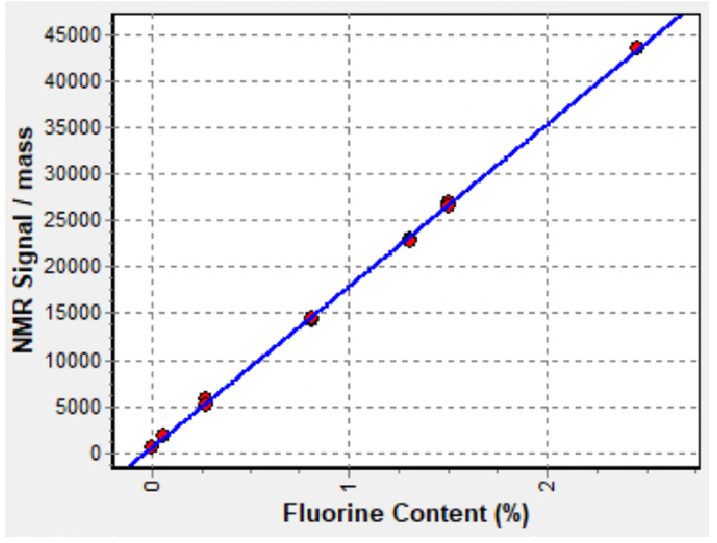
Fig. 1 — NMR calibration for fluorine content. Correlation Coefficient 1.00; Standard Deviation 0.015%
Measurements
A tared sample tube is filled to a given height with the fibre, or in this instance, textile sample, then weighed prior to NMR analysis. The samples are then conditioned at 40°C. Measurement time is 5 minutes per sample.
Results
Table 1 shows that the NMR measurement is repeatable.
| Repeat NMR measurements F-Content (Weight-%) | Mean F-Content (Weight-%) | Standard Deviation (Weight-%) |
| 0.69 | 0.68 | 0.70 | 0.73 | 0.68 | 0.69 | 0.72 | 0.70 | 0.02 |
Conclusions
- NMR is very stable over the long term and rarely needs calibration adjustment.
- Minimal sample preparation is required. The sample is measured “as is” without alteration.
- Measurement precision is good compared to wet chemical methods.
- Results can be obtained in minutes.
- The NMR technique is non-destructive so the same sample may be measured several times before being analysed by other techniques.
- With a different sample holder for measuring hydrogen, the NMR instrument may also be used for the measurement of other liquid coatings as well as finish removal.