Introduction
NMR Spectroscopy provides structural elucidation, quantification of target compounds and real-time synthesis reaction monitoring. Benchtop NMR instruments can be easily integrated into pharmaceutical workflows from drug development to manufacturing process and quality control. Hence, they enable immediate analysis of composition, purity and structure of synthesised compounds without taking samples to separately located central/core NMR facilities. The US Pharmacopoeia has approved NMR as a primary method of measurement, as the general quantitative NMR method leads to results without the need for an internal reference standard. High resolution proton NMR can be reliably obtained on the X-Pulse Benchtop NMR Spectrometer within a few minutes without the need for deuterated solvents.
In this Application Note, we discuss the structural identification and quantitative analysis of the Active Pharmaceutical Ingredient (API), Lansoprazole, using the Oxford Instruments X-Pulse Broadband Benchtop NMR Spectrometer. We additionally assess its wider use cases across pharmaceutical Research and Development.
Benchtop NMR in Pharmaceutical Workflows
The X-Pulse allows analysis of APIs using 1H NMR in a repeatable, efficient, and cost-effective manner which is critical to confirm drug efficacy, safety and quality. NMR can be implemented in the research, development, and manufacturing phases to aid the screening, formulation attempts, troubleshooting and quality control of the products. The results provide information on the amount of substance in the sample in relation to other components, whether that is a mixture of components in the sample, or the reference materials used for calibration.
One-dimensional NMR Spectroscopy
Many laryngitis patients suffer from gastroesophageal reflux (GERD). Lansoprazole (Figure 1), a gastric acid secretion reducer, is used to minimize symptoms. This API can be characterized using 1H NMR spectroscopy. A one-dimensional NMR measurement yields a data rich spectrum, where the structure composition, purity, and confirmation can be deduced.
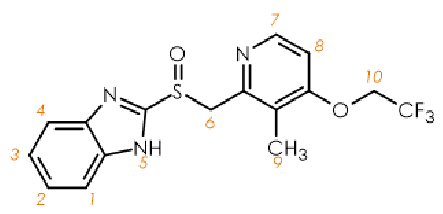
Fig. 1 — Structure of lansoprazole
Figure 2 shows the one-dimensional proton (1H) NMR spectrum for a 209 mmol/ℓ solution of lansoprazole in DMSO-d6. The spectrum was acquired using the simplest one-dimensional experiment, where a single radiofrequency (RF) pulse is applied followed by acquisition of the NMR signal.
The upfield resonance of 2.19 ppm is associated with the methyl group 9-CH3, 4.6–5.1 ppm are associated with the 6-CH2 and 10-OCH2 functional groups, 7.0–7.8 ppm are multiplets associated with the aromatic protons, 8.1–8.4 ppm are associated with the azomethine group. There is also a broad signal (not shown) at ca 13.5 ppm, associated with the cyclic amine 5-NH.
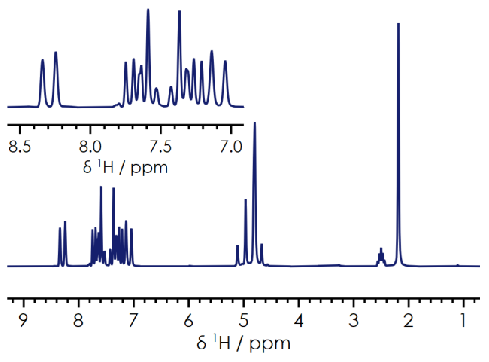
Fig. 2 — 1H one-dimensional spectrum of lansoprazole in DMSO-d6The one-dimensional spectrum acquired in just a few minutes contains sufficient information to identify the chemical composition and quantify the purity of lansoprazole from the different proton environments present.
NMR spectroscopy is inherently quantitative when preparation techniques, experimental methods, referencing techniques, and certain acquisition and processing parameters are optimized. The quantitative spectrum directly correlates the observed signal to the relative number of nuclei generating the signal. This accurate and precise determination of analytes is possible when the relaxation delay parameter is 5–7 times longer than the T1 for the analyte of interest. A long enough relaxation delay for the one-dimensional proton spectrum allows most of the nuclear spins in the system to reach bulk magnetization prior to the application of the RF pulse.
The inversion recovery measurement allows us to determine the time necessary between the radiofrequency (RF) pulses for the spins to relax and reach bulk magnetization. Figure 3 displays the inversion recovery measurement for lansoprazole.
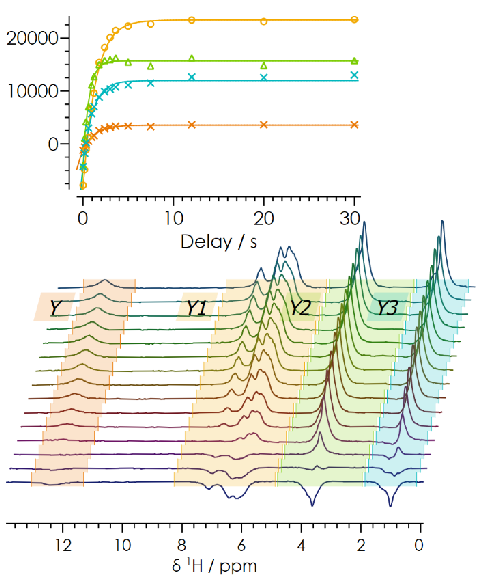
Fig. 3 — 1H inversion recovery for lansoprazoleEnsuring the relaxation delay is 5–7 times T1 removes any contributions that may arise from spin-spin and spin-lattice relaxations and leads to accurate quantification. One-dimensional proton NMR spectra for lansoprazole were collected with increasing relaxation delays of between one and twenty seconds (Figure 4). As the relaxation delay is increased, the number of relative nuclei present in solution is accurately determined. Once these parameters have been optimised, they can be saved in the X-Pulse acquisition software SpinFlow. The same experiment can then be repeated or automated with just a few clicks.
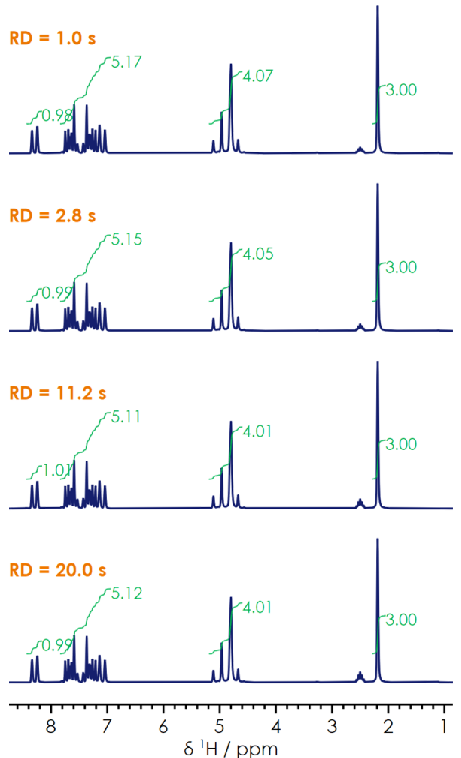
Fig. 4 — One-dimensional 1H NMR for lansoprazole with varied relaxation delay13C NMR spectrum was also obtained for lansoprazole (Figure 5). Chemical shifts associated with the ester and benzene rings are observed at 161.3, 150.9 & 148.0 ppm respectively. Alkene signals appear at 123.1 ppm, nitrogen substituted rings at 116.1 ppm and 60.0 ppm, and alkanes at 10.43 ppm.
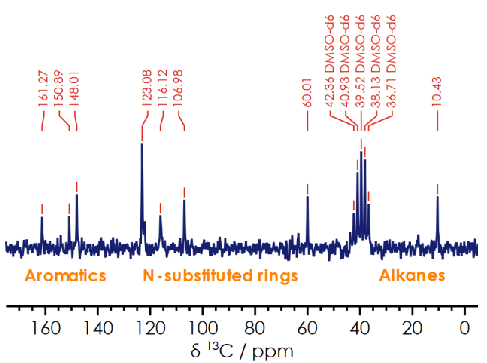
Fig. 5 — One-dimensional 13C{1H} spectrum for lansoprazoleThe information obtained from the one-dimensional carbon spectrum yields a greater understanding of the structure. This is especially helpful where the one-dimensional proton NMR contains some overlap. The signals associated with the aromatic region in the proton spectrum of lansoprazole is crowded; thus, having carbon decoupled NMR data gives us an opportunity to assign the ester and benzene rings with certainty. The decoupled 13C{1H} measurement produces a simpler spectrum deprived of overlapping peaks.
Two-dimensional NMR Spectroscopy
Two-dimensional spectra can help complement one-dimensional spectra analysis, particularly in cases where the one-dimensional data is too complex for interpretation due to overlapping signals. Two frequency dimensions lead to chemical shift and scalar coupling information, and they can be homonuclear or heteronuclear.
With the X-Pulse Benchtop NMR Spectrometer, homonuclear correlative spectroscopy (COSY) measurements can be obtained within 20 minutes. During the COSY experiment, magnetization is transferred by scalar coupling and protons within 2–3 chemical bonds yield cross signals. Figure 6 shows the COSY spectrum acquired for lansoprazole in DMSO-d6. The diagonal peaks correlate each proton environment with itself while the cross peaks correlate proton-proton couplings. Distinct cross peak signals are observed for the azomethine and methyl functional groups [8.32, 2.19 ppm], methylene and methyl [4.79, 2.19 ppm], and azomethine and aromatic protons [7.64, 8.34 ppm]. Two-dimensional COSY spectra separate and identify correlations present between different protons to ensure accurate structural identification of more complex molecules by removing any possible signal overlap. Here, COSY clearly illustrates the proton J-coupling present in the spectrum which is key for structure determination.
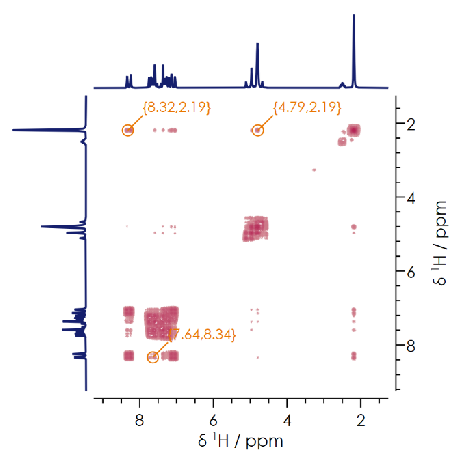
Fig. 6 — Two-dimensional 1H-1H COSY NMR spectrumHeteronuclear Single Quantum Coherence (HSQC) and Heteronuclear Multiple Bond Correlation (HMBC) experiments lead to valuable insights into 1H-13C couplings. The HSQC experiment provides single 1H-13C bond coupling information and the CH and CH3 groups are distinguished from the CH2 groups by the phase of the signal. The HMBC experiment shows connectivity of proton-carbons separated by 2–3 bonds. The HSQC and HMBC results for Lansoprazole are shown in Figure 7.
Single bond correlations are observed at [δH 2.17, δC 10.3 ppm] associated with the methyl group, 9-CH3; [δH 4.77, δC 60.0 ppm] for the OCH2 and nitrogen substituted ring functional groups, and [δH 7.02, δC 107.0 ppm], [δH 7.25, δC 123.1 ppm] for the aromatic and nitrogen substituted correlations. Multiple bond correlations [δH 4.79, δC 54.1 ppm], and [δH 8.23, δC 10.41 ppm] associated with CH2 and nitrogen substituted rings, and azomethine group and alkane correlations.
The ability to distinguish between single protons bound to carbons and multiple proton carbon bond correlations leads to full structure elucidation. The utility of two-dimensional spectra becomes increasingly important as the complex nature of the molecule increases. In many cases, the ability to identify the presence or absence of NMR resonances is crucial for structure determination. In pharmaceutical R&D, this provides instant proof that an API is being correctly synthesised in the lab, but this is just one of a raft of use cases for benchtop instruments.
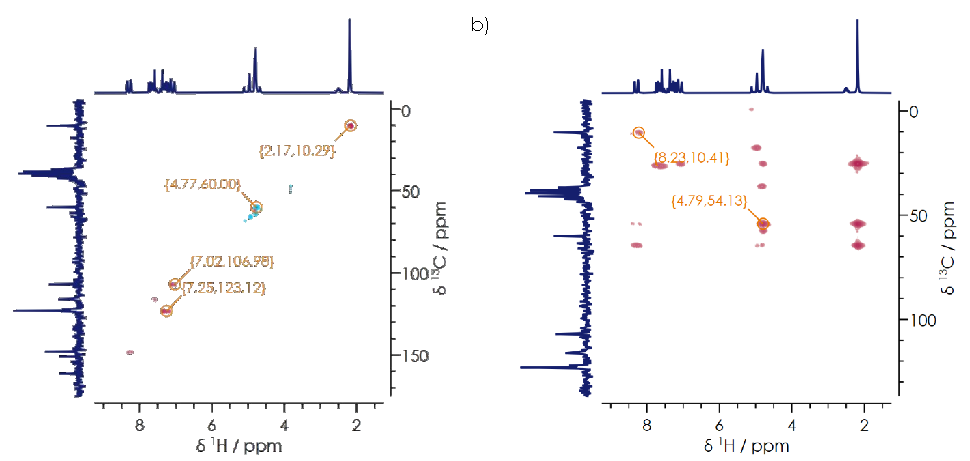
Fig. 7 — a) 1H-13C HSQC b) 1H-13C HMBC spectra for lansoprazoleWhy Benchtop NMR is Important Across Pharmaceutical R&D
In this specific example, we detailed step by step how to identify the composition, purity, and structure of an API from first principles. In practice, benchtop NMR instruments are also set up with pre-configured experimental procedures to enable fast, reliable assessment of different types of pharmaceutical materials. These include fragment screening of small molecule drug candidates, development of generics to reaction monitoring, screening for purity, and metabolomic identification of biomarkers in biofluids. These pre-configured experiments enable ‘walk-up’ acquisitions that can be used by any chemist, pharmacist or technician working in the laboratory environment.
The addition of an autosampler enables instrument operation 24/7 and allows longer duration experiments to be queued. Automated analysis routines additionally enable unattended batch processing of data that can be used to adjust reaction conditions in real-time. Benchtop NMR instruments are mobile and can be moved from lab to lab or across to fume hoods within a lab. Flow and variable temperature accessories extend uses to dynamic reaction monitoring of synthesis processes prior both to determining reaction effectiveness, and to assessing requirements for scale up.
Being inherently quantitative and identifying structure as well as composition, benchtop NMR offers key advantages over alternative methods such as FT-IR spectroscopy and mass spectroscopy. Importantly it is non-destructive, allowing both repeated measurements on the same sample without altering it, as well as subsequent analysis of the sample using a different technique.
Summary
Determination of the composition, confirmation, and purity of active pharmaceutical ingredients (API) demonstrates one important application for small footprint benchtop NMR in pharmaceutical R&D labs.
The wide range of benchtop NMR spectroscopy applications coupled with advances in automation, ease of use, and flow chemistry make NMR a powerful technique that can be used effectively across many pharmaceutical R&D workflows. For multiple use cases, these instruments now eliminate the need to go to central high field NMR facilities and enable instant data collection in any lab environment.
These experiments were executed with a standard configuration X-Pulse Benchtop Broadband NMR Spectrometer configurable with autosampler, flow chemistry, and variable temperature accessories.