Introduction
NMR spectroscopy is an analytical technique familiar to most chemists working in industry and academia, and is a
vital part of today's chemistry, biochemistry, food and pharmaceuticals research. NMR enables fast identification
of most organic substances by determining their chemical structure and can often quantify the amount of a specific
substance in samples. Benchtop NMR spectrometers use permanent magnets instead of the cryogen cooled superconducting
magnets used in high field NMR. They are consequently much smaller, easier to maintain and cheaper to run and can take
over routine work previously carried out using high field NMR instruments or complementary analytical techniques (e.g.
FT-IR, NIR, GC-MS and some chromatography techniques). Instruments can be placed in a laboratory or test facility and
can also be moved on a trolley to different factory locations. This now makes benchtop NMR spectroscopy an ideal
technique for quality control of raw materials, for in line process monitoring and end product quality assurance (QA).
Screening Applications of Benchtop NMR
Most analytical work on benchtop NMR spectrometers uses just the proton (1H) spectrum, but benchtop
instruments are perfectly capable of obtaining spectra from other NMR-sensitive nuclei including carbon
(13C), fluorine (19F), phosphorus (31P), lithium (7Li), boron
(11B), silicon (29Si), and many others. The Oxford Instruments X-Pulse instrument offers a
broadband option where a large range of NMR-sensitive nuclei can be accessed on a single instrument. Benchtop NMR
spectrometers typically work best for identifying molecules or compounds with molar masses around 600 g/mol or less.
In this range, the peaks in the spectra can be quantified by lower dispersion benchtop systems.
A common application for benchtop NMR is fast screening of samples to confirm molecular structure after a chemical
synthesis. This provides a QA tool, to check the quality and identity of incoming raw materials. They can additionally
check large numbers of samples quickly to see whether the expected peaks are present in the spectrum before passing
the samples on to high field systems for more detailed analysis. This saves a considerable time for the chemists doing
the syntheses and makes sure that the expensive high field instruments are used in the most efficient way.
We highlight below case study examples of QA screening from chemical suppliers to the (1) plastics and construction,
(2) fluoropolymers and (3) lithium battery industries.
Raw Materials Checking (1) – Fibreglass Sizing Compounds
In this example, a company making fibreglass was concerned about the quality of incoming chemicals used for glass
fibre sizing. They used an Oxford Instruments X-Pulse instrument to test three different samples, each provided by two
suppliers.
The user compared samples from the two suppliers that were supposed to be the same material. First, sample type 570
(Figure 1, above). Clearly the two spectra are identical, proving that the materials from supplier A and supplier B
are the same.
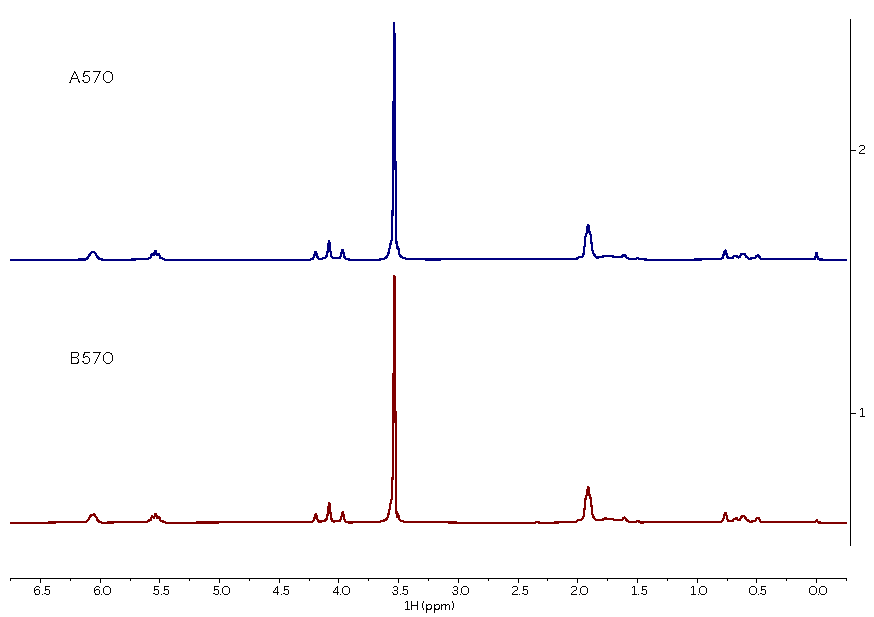
Fig. 1 — Comparison of spectra of sample type 570, from suppliers A and B.
We see the same with spectra from sample type 560, as in Figure 2. Again, the two spectra are identical, proving that
the materials from supplier A and supplier B are the same chemical.
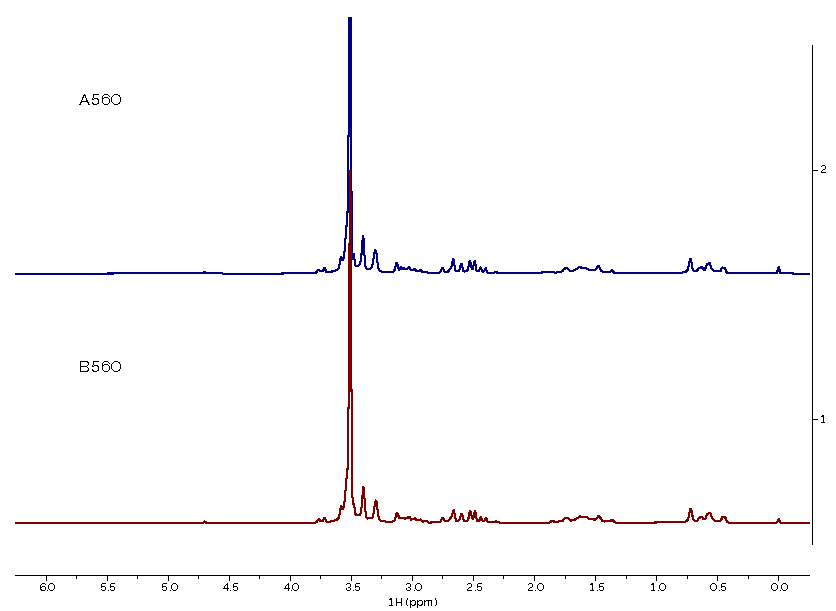
Fig. 2 — Comparison of spectra of sample type 560, from suppliers A and B.
However, when we compare the spectra from sample type 550 (Figure 3) we can immediately see that the spectra are not
the same, proving that the material from one of the suppliers is not the correct material or probably just wet.
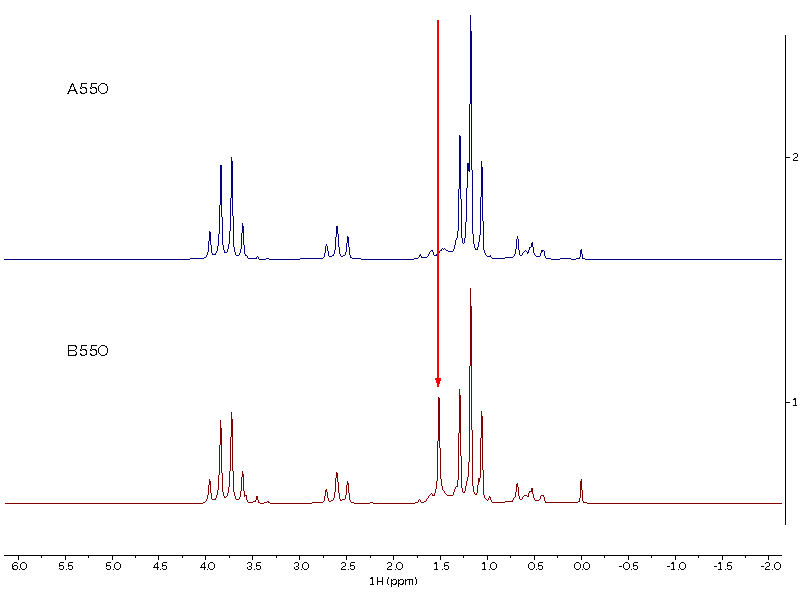
Fig. 3 — Comparison of spectra of sample type 550, from suppliers A and B.
Raw Materials Checking (2) – Fluorinated Chemical Feedstocks
In this example, a chemical manufacturer received a feedstock chemical from two different suppliers and found that
one of them worked in their reaction but the other didn't, costing the company a significant amount in both time
and money. They wanted to know if the cause of this was due to degradation, contamination, or another factor.
The feedstock chemical was 2,3-dichloro-1,1,1-trifluoropropane, a relatively simple molecule that generates a
surprisingly complex 1H NMR spectrum given that it has only three hydrogen atoms. We first looked at the
1H spectrum of a reference sample of this material and compared that to the spectrum of the
"failed" material. Figure 4 shows the two spectra.
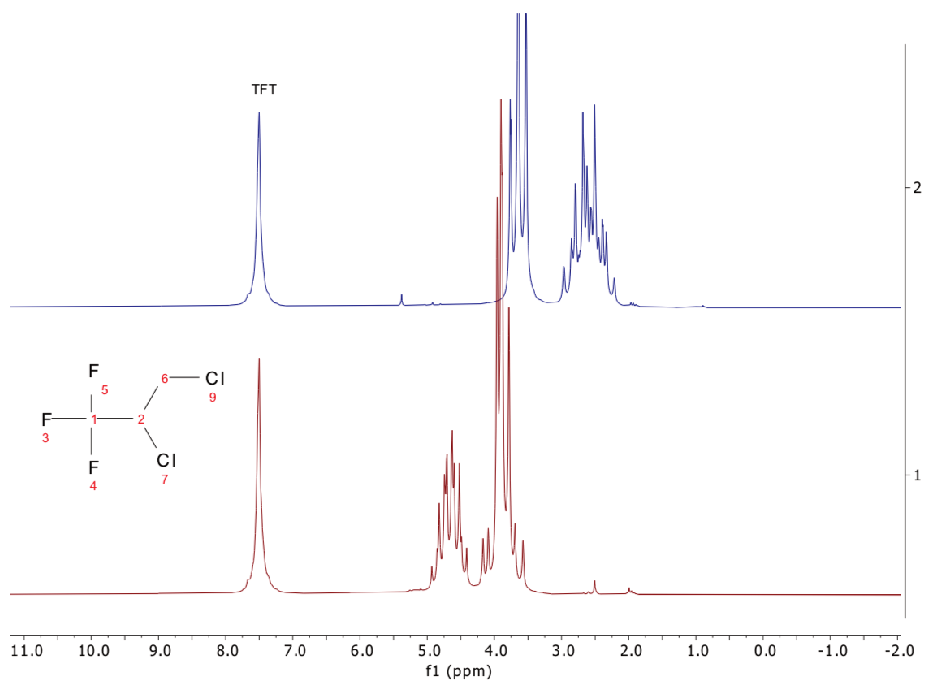
It is clear that there are big differences between the two spectra, so we can tell immediately that the reason for
the failure of the reaction is that this supplier's feedstock is chemically different from what was claimed.
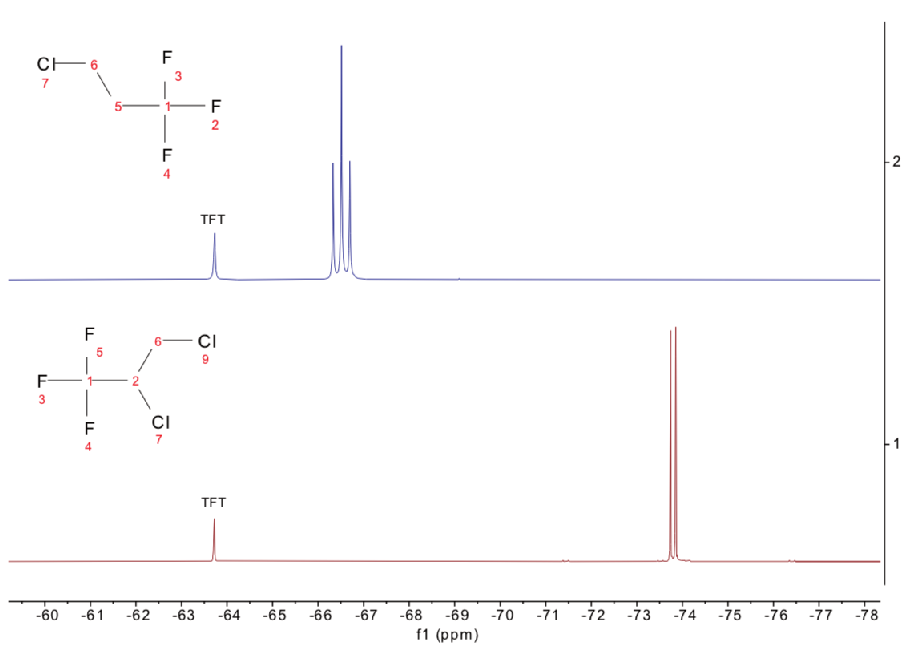
To confirm this conclusion, we then looked at the 19F spectra which is extremely straightforward to
interpret and again saw very large differences between them, as shown in Figure 5.
By looking also at the 13C spectra (not shown here) we were able to identify that the "failed"
material was in fact 3-chloro-1,1,1-trifluoropropane and not 2,3-dichloro-1,1,1-trifluoropropane and was mislabelled.
Because the full structural determination is not necessary to screen a compound, either the 1H or the
19F spectra alone can provide the yes/no QA answer. Both can be acquired in approximately 1 minute enabling
a fast and, when needed, high throughput checking process.
Final Product Checking (1) – Electrolytes for Lithium Ion Batteries
In this case study, a chemical manufacturer had two different batches of their final product, a typical battery
electrolyte of lithium hexafluorophosphate, Li[PF6], in a mixture of two carbonated solvents, ethyl methyl
carbonate (EMC) and ethylene carbonate (EC). Although to the eye the two batches B1 and B2 looked identical, it was
found that batch B2 had very different performance characteristics to those expected when placed inside a battery
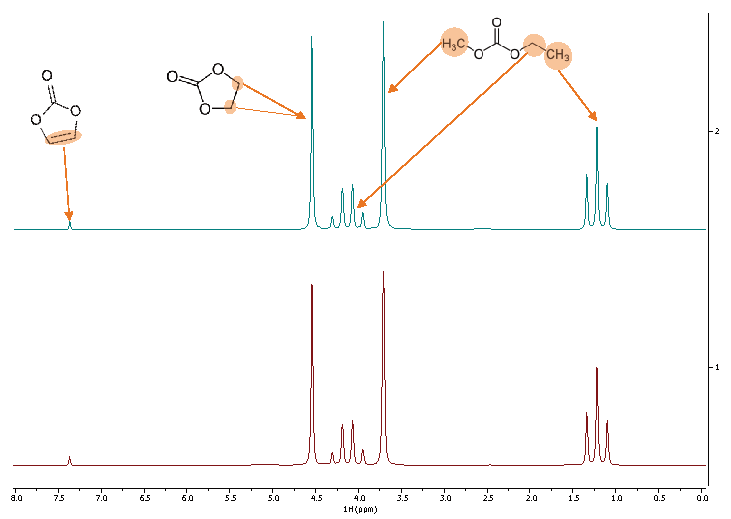
cell. As with the previous examples, initially the 1H spectra of the two compounds were collected. The
spectra both show all the expected peaks for the 1H nuclei in the two solvents as identified in Figure 6.
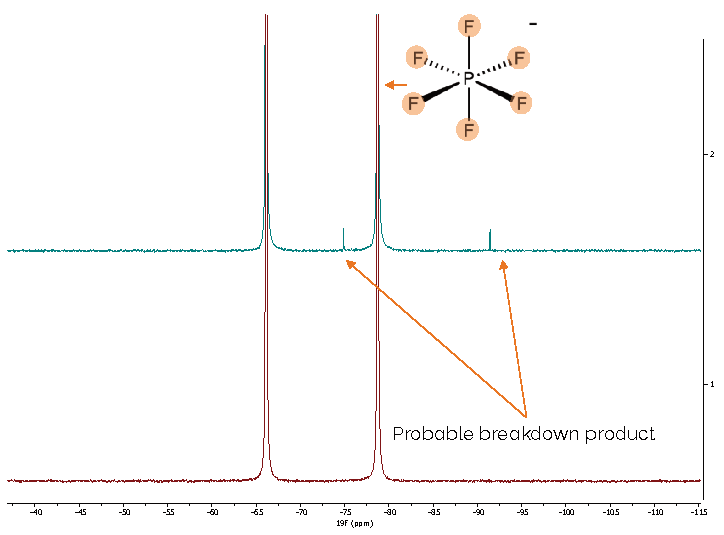
Visually, they appear identical. Again, as with the previous example, the next test was to measure the 19F
spectrum; in these samples this will specifically probe the Li-salt and will identify if the source of the performance
difference can be found there. When comparing the spectra in Figure 7, the difference is immediately apparent. In
sample B2 the expected doublet from the [PF6]- is also accompanied by a second doublet. This
doublet corresponds to OPF2(OH), a common breakdown product of Li[PF6] when exposed to water in
the presence of carbonated solvents. This clearly identifies the cause of the performance difference between the two
electrolytes.
Conclusions
In the examples presented, similarities and differences in the "good" and "bad" spectra can be
spotted with the naked eye, and without any knowledge of the chemical structure of the compounds. This enables
"Go - No Go" test methods for incoming raw materials that can be formalised with spectral pattern matching
to reference databases.
For many QA/QC and raw materials screening applications, especially for low molecular weight molecules, modern
benchtop NMR spectrometers now provide a faster, more convenient and low-cost solution. They can replace or complement
analytical methods such as GC-MS, FT-IR and chromatography as well as more complex, expensive high field NMR
instruments. Their speed and simplicity of use creates significant cost and time savings for both low volume and high
throughput uses.
About the Oxford Instruments X-Pulse
X-Pulse is a high-resolution benchtop NMR spectrometer. Using a high stability 60 MHz (1.4 T) permanent magnet,
X-Pulse enables users to collect NMR data without the need for liquid cryogens or specialist facilities. X-Pulse has
been optimised with unique shimming technology to provide resolution of better than 0.35 Hz. For convenience, X-Pulse
uses standard 5 mm NMR tubes requiring only 300 μl of sample. X-Pulse is the first benchtop NMR system to have a
broadband X-Nuclei channel allowing users to select the nucleus that is right for their own application including
carbon, phosphorous, lithium, boron, silicon and many more.
X-Pulse is controlled by the user friendly SpinFlow software interface. This software allows users to control every
aspect of the instrument. For quality control applications like those described above, specific experiments can be
stored and run using a single mouse click to ensure repeatability and consistency between measurements.